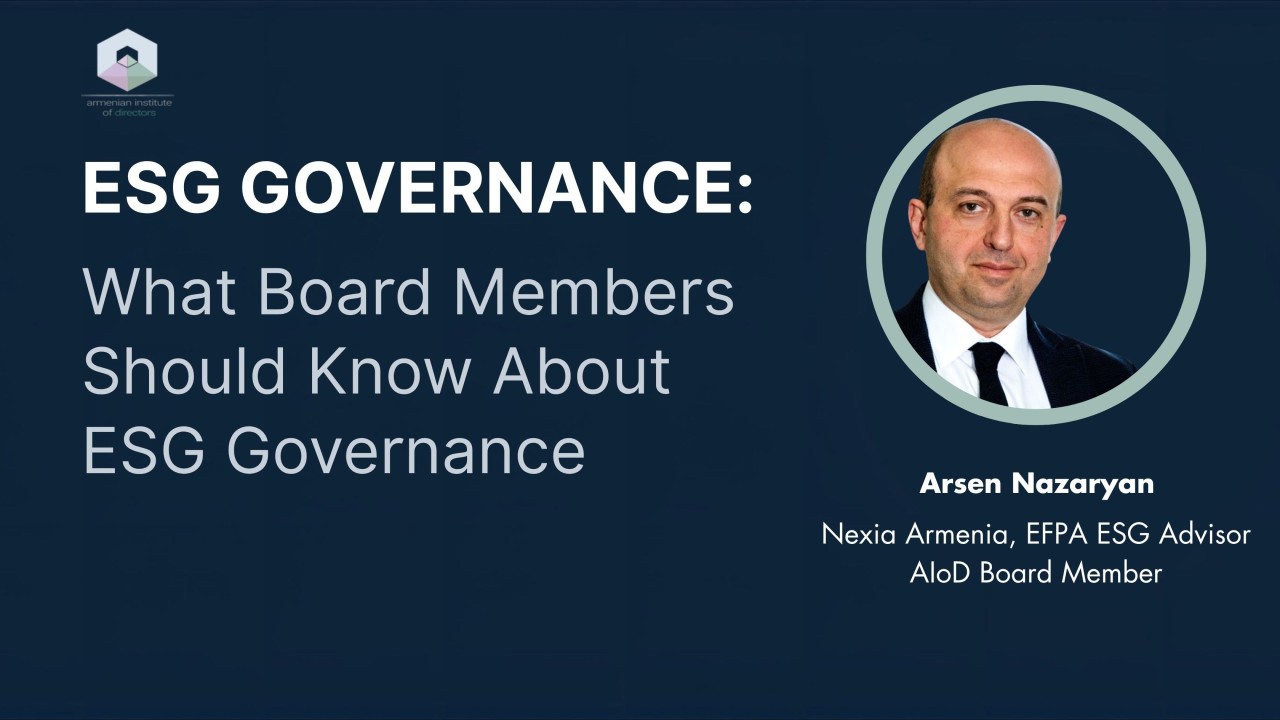

What Board Members Should Know About ESG Governance
A Practical Guide for Directors and CEOs
By Arsen Nazaryan, Nexia Armenia, EFPA ESG Advisor, AIoD Board Member
Over the past 4–5 years (what many of us think of as post-COVID life), ESG (Environmental, Social, and Governance) considerations have moved from the periphery of corporate life to its very center. Even in a small, developing economy like Armenia, this shift is happening now.
International lenders, local banks, trading partners, and investors are already asking questions that Boards and CEOs must be able to answer. This guide is our modest attempt to share some ideas about ESG governance within the Armenian context.
THE CORE INSIGHT: ESG IS SIMPLER THAN YOU THINK.
ESG is not inherently complex (unless you allow consultants or jargon to make it so). At least the first analysis and report should not be complicated. ESG is about running a responsible and resilient business. Most organizations struggle not because the framework is difficult, but because they overcomplicate the purpose. Please keep it simple, practical, and keep it strategic. And it will serve you well.
1. The Board’s Role: Oversight, Not Management
Effective ESG governance is not about boards managing day-to-day sustainability programs. The board’s role in ESG governance is about oversight, direction, and accountability (setting the standard and holding management responsible for delivering it).
1.1 Setting the Tone
Everything begins with clarity on why ESG matters to your specific company. A board that treats ESG as a "tick-box" exercise will produce a tick-box culture throughout the organization. Boards must be able to articulate clearly how sustainability connects to long-term strategy. There are 3 key questions every board should be able to answer:
Resilience: How do ESG factors affect our ability to grow and operate over the next 5–10 years?
Materiality: Which environmental or social issues pose big risks and opportunities for our specific business?
Integrity: Can our stated values guide corporate decisions when difficult trade-offs arise?
1.2 Integrating ESG into Strategy
ESG should shape strategy from the start, which basically means:
· Considering climate changes, resources, and social trends when approving long-term business plans.
· Applying an ESG lens before evaluating major business decisions (investments, acquisitions, market entries, etc.).
· Identifying ways in which corporate sustainability can create competitive advantage or new revenue.
1.3 Governance Structures and Accountability
Boards must ensure there is a clear internal framework for ESG oversight.
Over the last 2-3 years, several leading organizations in Armenia (such as ZCMC and commercial banks) have integrated ESG into their board-level oversight, though their structures vary.
What matters is that someone is accountable and that ESG performance is regularly reviewed by the board. How can it be done?
· Assigning oversight to an existing committee (Audit or Risk).
· Establishing a dedicated committee as the organization matures.
· Defining clear escalation paths for management responsibilities.
ARMENIAN LEGAL CONTEXT: FIDUCIARY DUTY
The 2024 Code of Corporate Governance has introduced an important requirement: companies are now required to publish their sustainability report as an integral part of their annual report. ESG governance is no longer a separate "voluntary" obligation; it is a modern extension of your "Duty of Care" and "Duty of Loyalty" under Armenian law.
2. Risk Oversight and Internal Controls
Any ESG risk (be it an environmental incident, a workplace safety failure, or a corruption allegation) can escalate into a crisis within days. Thus, boards should ensure that ESG risks are:
· Identified through structured risk assessments (at least annually).
· Integrated into the company’s Enterprise Risk Management (ERM) framework.
· Supported by internal controls, clear policies, and functioning whistleblowing mechanisms.
3. Metrics, Targets, and Executive Incentives
Boards should require management to define clear ESG metrics that are:
· Relevant to the company’s actual activities and material risks.
· Consistent over time, so progress can be tracked meaningfully.
· Linked to strategic priorities, not chosen for appearance.
Good international practice recommends linking executive remuneration to ESG performance (such as safety rates, emissions reductions, and employee turnover). This is a clear message that ESG and corporate sustainability are part of how the business defines success.
4. ESG Reporting: Oversight Without Micromanagement
Under the 2024 Code of Corporate Governance, ESG data is no longer a "standalone" PR effort. And because it must be part of the Annual Report, Boards have critical oversight responsibilities:
Accuracy: Ensuring disclosures are accurate and consistent with financial statements.
Assumptions: Understanding the key assumptions behind reported ESG figures.
Preventing "Greenwashing": Avoiding exaggerated or misleading claims that create legal and reputational exposure.
REPORTING FRAMEWORKS:
While Armenia is moving toward mandatory integration via the 2024 Code, companies receiving financing from the EBRD or IFC are typically required to report against specific ESG performance standards. Early adoption of recognized international frameworks (GRI, VSME, or IFRS S1/S2) provides a strong and credible basis for these high-level conversations.
5. Board Competence and Culture
Effective ESG governance depends on the board’s collective capability. Not every director needs to be an ESG specialist, but the board should have enough ESG literacy to ask the right questions.
Recruitment: Including ESG expertise as a criterion in director recruitment and succession planning.
Education: Engaging in regular sessions on sustainability trends and Armenian regulatory developments.
Diversity: A board with diverse perspectives is naturally better equipped to identify social and governance risks that a monolithic board might overlook.
6. ESG in Armenia: Challenges and Opportunities
6.1 Challenges
· Regulatory frameworks are still developing, and requirements can be uneven across sectors.
· Internal capacity and ESG data/benchmarking tools are often limited.
· Short-term financial pressures can make long-term ESG investment hard to justify.
6.2 Opportunities
Preferred Financing: Strong ESG governance attracts EBRD, IFC, and international capital on more favorable terms.
EU-Armenia CEPA: Alignment with these standards strengthens Armenia's trade position.
CBA Alignment: The Central Bank of Armenia has begun integrating sustainability into its supervisory framework for financial institutions.
7. Common Pitfalls to Avoid
Treating ESG as a Compliance-Only Exercise: Compliance sets the ground, not the ceiling.
Total Delegation: Signing off on ESG reports without understanding the data carries significant risk.
Metric Overload: Focusing on "more numbers, pictures, and data" rather than "clear and better information."
Reactive Governance: Waiting for a crisis or investor complaint before setting up an agenda.
Outsourcing Ownership: Allowing consultants to turn a straightforward business concept into an overcomplicated and unmanageable program.
Treating ESG as a Reporting Exercise. Reporting is not a goal but a tool for collecting data, conducting the right analysis, and recommending strategy adjustments.
8. ESG As a Test of Board Effectiveness
ESG governance is ultimately a test of how well a board fulfills its core mandate: protecting and building the company's long-term value.
For Armenian companies, the urgency is real. International capital, trading relationships, and regulatory alignment all depend on credible governance.
ESG is not complicated. It requires a board that is engaged, honest about risks, and willing to embed sustainability into how the business makes decisions. Boards that do this build stronger, more profitable, and more trusted organizations.
In mid-2026, even in Armenia, the question is no longer whether ESG belongs in the boardroom or not. It is “how well ESG is governed by the Board”.